设为首页 加为收藏 联系我们
当前时间:
咨询热线:400-1010-468  
http://www.shbzsw.com.cn  
E-mail:SHBZSW@163.COM  
地址:上海市世贸大厦
行业新闻 您的当前位置:首页 -> 新闻中心 -> 行业新闻  
 
干细胞治疗ED:重构男性健康的再生医学路径
发布时间:2026-03-26 文章来源:本站  浏览次数:41

全球约2.5%–12%男性受不育困扰,传统药物与辅助生殖对睾丸损伤、非梗阻性无精症(NOA)疗效有限。间充质干细胞(MSCs)及外泌体(MSC‑Exos)凭借生殖细胞分化、抗氧化、抗炎、抗凋亡、激素调控、自噬调节,为男性不育提供全新再生路径。本文系统梳理不同来源MSCs/MSC‑Exos的治疗机制、临床证据与转化挑战,为难治性男性不育提供严谨学术参考。

图片

01


男性不育:从病因到治疗困境


男性不育以少精、弱精、畸精、无精为核心表型,常见病因包括化疗/放疗损伤、精索静脉曲张、睾丸扭转、糖尿病、感染、环境污染与特发性生精衰竭。现有疗法难以修复睾丸微环境与生精功能损伤,再生医学成为破局关键。

MSCs具备易获取、低免疫原、少伦理、强旁分泌优势,可分化为生殖相关细胞、重建生精微环境;MSC‑Exos继承母细胞疗效,无细胞输注风险、易标准化、可储存,成为下一代无细胞治疗核心。

Diagram illustrating the role of mesenchymal stem cells (MSCs) in male infertility treatment. The central part shows MSCs derived from bone marrow, adipose tissues, and umbilical cords. Surrounding sections indicate their effects: repairing the blood-testis barrier, restoring spermatogenesis, providing immune regulation, antioxidative stress, anti-apoptosis, and secretion of growth factors. The outer part connects these functions with male infertility solutions, focusing on repair, organizational repair, and hormonal regulation. Arrows and icons further emphasize these processes.


图片


02


MSCs治疗男性不育的核心机制


1. 生殖细胞分化:体外/体内定向分化为精原/生精细胞,表达VASA、DAZL、PLZF、SCP3等标志物,恢复生精谱系。

2. 抗氧化应激:提升SOD、GSH、TAC,降低ROS、MDA,保护线粒体与DNA,缓解高温、毒素、代谢异常导致的睾丸损伤。

3. 抗炎与免疫调节:下调TNF‑α、IL‑1β,上调IL‑10、TGF‑β1,减轻睾丸炎症浸润与纤维化。

4. 抗过度凋亡:下调Caspase‑3、Bax,上调Bcl‑2,阻断线粒体凋亡通路,减少生精细胞丢失。

5. 激素与屏障修复:恢复FSH、LH、睾酮稳态;上调Claudin‑11,修复血睾屏障(BTB)。

6. 自噬稳态调控:校正LC3、p62异常,维持生精细胞代谢与存活平衡。
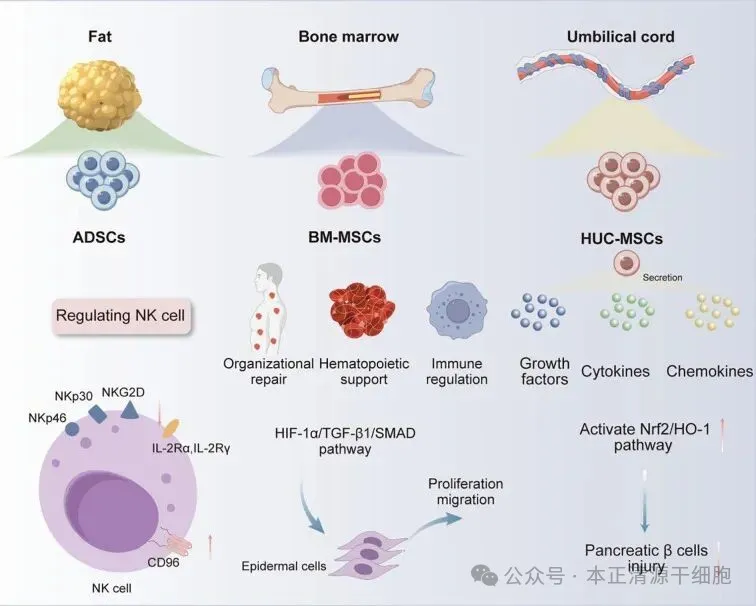
Diagram illustrating the sources and functions of mesenchymal stem cells (MSCs) from fat, bone marrow, and umbilical cord. It shows ADSCs, BM-MSCs, and HUC-MSCs' roles in regulating NK cells, organizational repair, hematopoietic support, immune regulation, and secretion of growth factors, cytokines, and chemokines. Pathways like HIF-1 alpha/TGF-beta 1/SMAD are involved in cellular proliferation and migration. The Nrf2/HO-1 pathway activation is linked to pancreatic beta cell injury prevention. Various receptors and pathways related to NK cells are depicted, including NKp30, NKG2D, and CD96.

常用MSC的分类与特征

图片

03


MSCs来源与治疗证据


<, p style="-webkit-tap-highlight-color: rgba(0, 0, 0, 0); margin: 0px; padding: 0px; outline: 0px; max-width: 100%; clear: both; min-height: 1em; font-size: 14px; letter-spacing: 1.5px; line-height: 1.71; font-family: 默认字体; box-sizing: border-box !important; overflow-wrap: break-word !important;"> 脐带MSC(UC‑MSC)

来源丰富、低免疫原、高分泌,适合睾丸扭转、化疗损伤、生精衰竭。

机制:强效抗炎、促血管生成、激活AKT/mTOR通路,修复生精小管;体内可长期存活并分化为生殖细胞。

Diagram illustrating the role of adipose-derived stem cells (ADSCs) in testicular function. The main sections include anti-oxidative stress, antiapoptosis, autocrine growth factors, and hormone regulation. In the anti-oxidative stress area, ADSCs regulate antioxidant enzymes reducing ROS. The antiapoptosis section shows inhibition of apoptosis and germ cell death. The autocrine growth factors area indicates promotion of germ cell proliferation, angiogenesis, and blood-testis barrier repair. Lastly, hormone regulation features microenvironment reconstruction, hormone recovery, and enhancement of sperm production efficiency.

MSC在男性不孕治疗中的应用

图片

04


MSC‑Exos:无细胞治疗新范式


MSC‑Exos(30–150 nm)携带miRNA、mRNA、蛋白、脂质,靶向修复睾丸,规避细胞移植风险。

• 化疗生殖损伤:MSC‑Exos抑制p38MAPK/ERK、AKT通路,修复环磷酰胺致睾丸损伤。

• 氧化/凋亡保护:UC‑MSC‑Exos降低ROS、上调Bcl‑2、下调Caspase‑3,促进生殖细胞增殖迁移。

• 环境毒物防护:iMSC‑Exos减轻镉致DNA损伤与自噬缺陷,恢复精子发生。

• 精子保存:提升冻融精子存活率、活力与抗氧化能力,改善辅助生殖配子质量。

• 抗感染潜力:对沙眼衣原体等生殖道感染相关不育,具备抗炎与修复前景。

图片

05


未来方向:工程化与精准化


• 工程化修饰:基因编辑增强靶向性与疗效;3D培养提升外泌体产量与稳定性。

• 递送优化:睾丸靶向注射、水凝胶/支架缓释,提高局部滞留与作用时长。

• 联合疗法:MSCs/Exos+激素、抗氧化、手术、ART,提升妊娠与活产率。

• 组织工程睾丸:体外重构生精微环境,为重度NOA提供精子来源。

图片

图片
图片
图片


上一篇: 干细胞是如何在心梗预防中发挥作用的
下一篇: 干细胞干预心肌梗塞,让梗死面积明显减小
关于我们  |  公司掠影  |  新闻中心  | 联系方式  |  在线留言
版权所有 Copyright(C)2015-2016 上海本正清源干细胞科技集团有限公司